Mt. Rushmore History
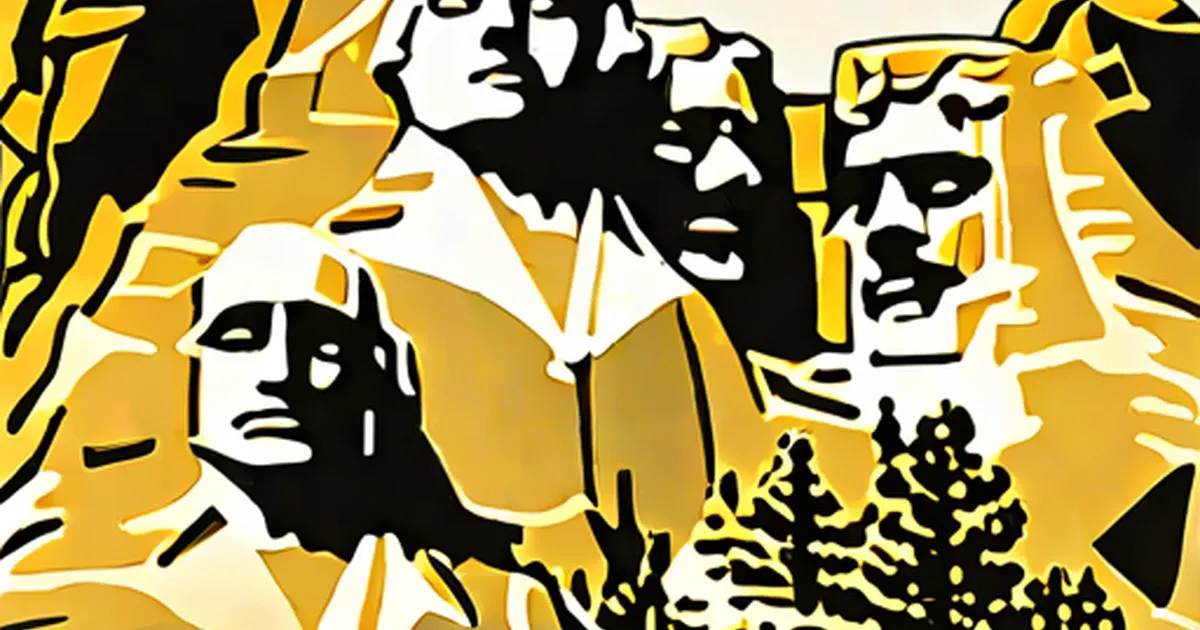
Mt. Rushmore stands as an epic of the heroes of American history. Get to know the important facts about Mount Rushmore in Mount Rushmore's history.
"Until the wind and the rain alone shall wear them away." So go the words of Gutzon Borglum on the long-lasting nature of his renowned work, Mt. Rushmore. Located near Keystone in the Black Hills of South Dakota, this "Shrine of Democracy" is a huge granite sculpture that commemorates four epoch-making presidents and typifies the first 150 years of the history of the United States. It remains the most popular tourist spot in South Dakota.
How the Project Began
The project was undertaken to attract tourists to the Black Hills region. Doane Robinson, a South Dakota state historian, conceived the idea in 1923 of carving eminent people into the mountain, and after Congressional approval the carving began in 1927. The famous sculptor Gutzon Borglum was called upon to undertake it. Originally the granite pillars called the Needles were to be carved, but Borglum found them too thin and chose Mount Rushmore instead — it faced southeast (so it caught sunlight for most of the day), was the highest peak in the region, and was made of erosion-resistant granite. On seeing it he said, "America will march along that skyline."
The Four Presidents
Borglum chose four presidents to "commemorate the founding, growth, preservation, and development of the United States." George Washington was chosen for leading the nation to democracy; Thomas Jefferson for authoring the Declaration of Independence and the concept of "government by the people"; Abraham Lincoln for ending slavery; and Theodore Roosevelt — picked by Borglum himself — for advancing the construction of the Panama Canal and promoting the causes of conservation and business reform.
Carving the Mountain
Borglum used the ancient Greek method of making models and mapping measurements from the model to the mountain, one inch on the model scaling to one foot on the rock. Carving commenced on October 4, 1927. Rock was removed with dynamite until a 3–6 inch layer of granite remained, after which "honeycombing" and tools such as air-powered hammers, wedges and nails were used to remove the final layer and smooth the surface; about 800 million pounds of rock was removed in all. Julian Spotts, a National Park Service engineer, suggested upgrades that improved working conditions and machine efficiency. Borglum had estimated the work would take no more than 6 years and about $500,000; it was completed in 1941 and ended up costing about $900,000 (close to a million dollars).
Sculpting began with George Washington, whose head was first carved into an egg shape. Jefferson was to be carved to Washington's right, but after about two years the rock there was found to have cracked, so it was blasted off and Jefferson was given a new place to the left of Washington. Washington's face was unveiled — from beneath an enormous flag — on July 4, 1934. Jefferson was dedicated in 1936 with President Franklin Roosevelt in attendance; Lincoln on September 17, 1937; and Theodore Roosevelt in 1939, when the newly installed lighting slowly illuminated his face amid fireworks. The work finished in 1941, a seemingly impossible dream come true.
Important Facts About Mount Rushmore
There is an interesting story behind the name: while Charles Rushmore, David Swanzey and Bill Challis were on an expedition to the mountain, Rushmore asked its name, and Bill replied that it had none and should be called Mount Rushmore from then on.
- Gutzon Borglum was 60 when the work started, and it continued for 14 long years. During construction the workers climbed 506 steps to reach the top.
- During the Great Depression, an appeal was made to America's schoolchildren to donate; they hoped to collect $10,000 but raised $1,700 — so even the children had a share in funding the project.
- The sculpted faces rise up to 5,500 feet above sea level. Each head is as high as a six-story building, and, measured from the top of the head to the chin, as high as the Great Sphinx of Egypt. If a torso had been attached to scale, the whole figure would have measured 465 feet.
- Washington's face is 60 feet long, each nose is 20 feet in length, each mouth 18 feet wide, and the eyes 11 feet across — with 22-inch pupils carved into each to bring the faces to life.
- The pneumatic drills the workers used weighed as much as 85 pounds, and the men worked hung from the cliff by cables; many later suffered silicosis from breathing granite dust. Around 400 men worked on the project, and remarkably, not a single death was reported despite the risks and the use of dynamite.
- The entire Mount Rushmore National Memorial covers over 1,278 acres, is managed by the National Park Service, and attracts about 2 million visitors annually.
South Dakota's Black Hills stand in the background, and programs such as studio talks, Presidential Trail walks and the spectacular evening lighting ceremony are held at the memorial; the Avenue of Flags, flying the flags of 56 states and territories, runs from the Concession Building to the Grandview Terrace. Plant life includes shrubs and flowers such as snapdragon and violet, and the surrounding Ponderosa forests — which see fires roughly every 27 years — are home to bald eagles, hawks, mice, chipmunks, frogs and snakes. Today, Mt. Rushmore stands as a testimonial to the craftsmanship of Gutzon Borglum and his workers, having immortalized the heroes of American history.