Accomplishments of Isaac Newton
Isaac Newton was one of the most important figures in science. We owe a major part of our understanding of the universe to his scientific discoveries. To know about the accomplishments of Isaac Newton, read on…
Who was the first one to discover the relationship between external force and motion? Who derived the relationship between force and momentum? And who was it to postulate the famous principle of equal and opposite reactions? I am sure you have guessed it right! It was Sir Isaac Newton.
Born on January 4, 1643, Sir Isaac Newton was an English physicist, mathematician and astronomer. He was also a natural philosopher and alchemist. He was a student of The King’s School, Grantham. He dropped out from school and was later admitted to the Trinity College, Cambridge. His work in science and mechanics made him one of the most influential figures in history. He expired on March 31, 1727, leaving behind a legacy of his brilliant discoveries. Let us look at his major accomplishments.
Accomplishments of Isaac Newton
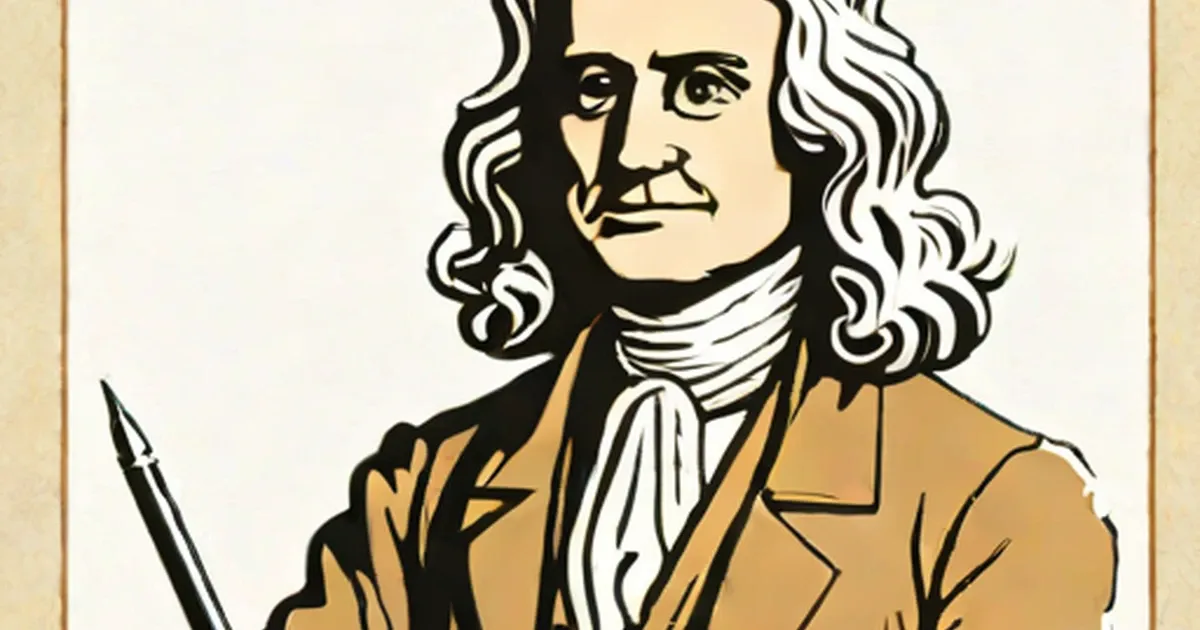
The Newton’s Laws of Motion became the founding principle of mechanics and enlightened the masses about the relationships between force and motion. He published his works in the ‘Philosophieae Naturalis Principia Mathematica’ in 1687. This book is regarded as one of the most significant literary works in science. It earned Newton international acclaim. He also devised the principles of angular momentum and the conservation of momentum.
The incident of Newton seeing an apple fall straight down from a tree is known to one and all. His observation led him to the discovery of the gravitational force. It was Newton who showed that the gravitational force extends across the Earth and varies inversely with the square of distance. His theory led to the calculation of the orbital period of the Moon. By establishing the close relationship between the Kepler’s laws of planetary motion and his gravitational theory, Newton proclaimed that the same natural laws are responsible for the motion of both the Earth and other celestial bodies.
In 1665, Isaac Newton invented the generalized binomial theorem and started working on the development of a mathematical theory, which went on to become the infinitesimal calculus, a very important branch of mathematics.
Newton’s identities, which are used to find the relationship between power sums and elementary symmetric polynomials and the Newton’s method that is used for finding successive approximations of a real-valued function, were some of the other important discoveries of Sir Isaac Newton. The first successful use of the power series in polynomial theory is attributed to Newton. He also devised a new formula to calculate Pi.
During the initial years of the 1670s, Newton worked in the field of optics. His work led to the discovery that a prism can decompose white light into a spectrum of colors. He was successful in demonstrating that a combination of a lens and a prism could recompose a spectrum of colors into white light. He discovered that color is an outcome of objects reflecting colored light. This discovery became famous by the name, ‘Newton’s Theory of Color’. Isaac Newton is famed for the invention of the reflecting telescope.
During his later years, Newton was the President of the Royal Society and was associated with the French Academie des Sciences, a learned society established with an aim of promoting French scientific research.
Isaac Newton tops the list of the most influential scientists in human history and is commemorated for his revolutionary discoveries in the fields of mathematics and science.

Born on January 4, 1643, Sir Isaac Newton was an English physicist, mathematician and astronomer. He was also a natural philosopher and alchemist. He was a student of The King’s School, Grantham. He dropped out from school and was later admitted to the Trinity College, Cambridge. His work in science and mechanics made him one of the most influential figures in history. He expired on March 31, 1727, leaving behind a legacy of his brilliant discoveries. Let us look at his major accomplishments.
Accomplishments of Isaac Newton
The Newton’s Laws of Motion became the founding principle of mechanics and enlightened the masses about the relationships between force and motion. He published his works in the ‘Philosophieae Naturalis Principia Mathematica’ in 1687. This book is regarded as one of the most significant literary works in science. It earned Newton international acclaim. He also devised the principles of angular momentum and the conservation of momentum.
The incident of Newton seeing an apple fall straight down from a tree is known to one and all. His observation led him to the discovery of the gravitational force. It was Newton who showed that the gravitational force extends across the Earth and varies inversely with the square of distance. His theory led to the calculation of the orbital period of the Moon. By establishing the close relationship between the Kepler’s laws of planetary motion and his gravitational theory, Newton proclaimed that the same natural laws are responsible for the motion of both the Earth and other celestial bodies.
In 1665, Isaac Newton invented the generalized binomial theorem and started working on the development of a mathematical theory, which went on to become the infinitesimal calculus, a very important branch of mathematics.
Newton’s identities, which are used to find the relationship between power sums and elementary symmetric polynomials and the Newton’s method that is used for finding successive approximations of a real-valued function, were some of the other important discoveries of Sir Isaac Newton. The first successful use of the power series in polynomial theory is attributed to Newton. He also devised a new formula to calculate Pi.
During the initial years of the 1670s, Newton worked in the field of optics. His work led to the discovery that a prism can decompose white light into a spectrum of colors. He was successful in demonstrating that a combination of a lens and a prism could recompose a spectrum of colors into white light. He discovered that color is an outcome of objects reflecting colored light. This discovery became famous by the name, ‘Newton’s Theory of Color’. Isaac Newton is famed for the invention of the reflecting telescope.
During his later years, Newton was the President of the Royal Society and was associated with the French Academie des Sciences, a learned society established with an aim of promoting French scientific research.
Isaac Newton tops the list of the most influential scientists in human history and is commemorated for his revolutionary discoveries in the fields of mathematics and science.


Use the feedback form below to submit your comments.

Use the form below to email this article to your friends.

- Isaac Newton Predicts Apocalypse
- How Newton’s Telescope Changed the World
- Newton Papers on Show in Israel
- A straight look at Diffraction
- Newton’s Third Law: Some explanations
- Charles Darwin Biography
- Thomas Alva Edison Biography
- Alexander Graham Bell Biography
- Albert Einstein: Biography
- Famous Mathematicians
- Does the Fourth (4th) Dimension of Time Exist
- Timeline and Biography of Sir Isaac Newton